Vision-Driven End-to-End Motion Planning for UAVs Using Privileged Imitation Learning
Abstract
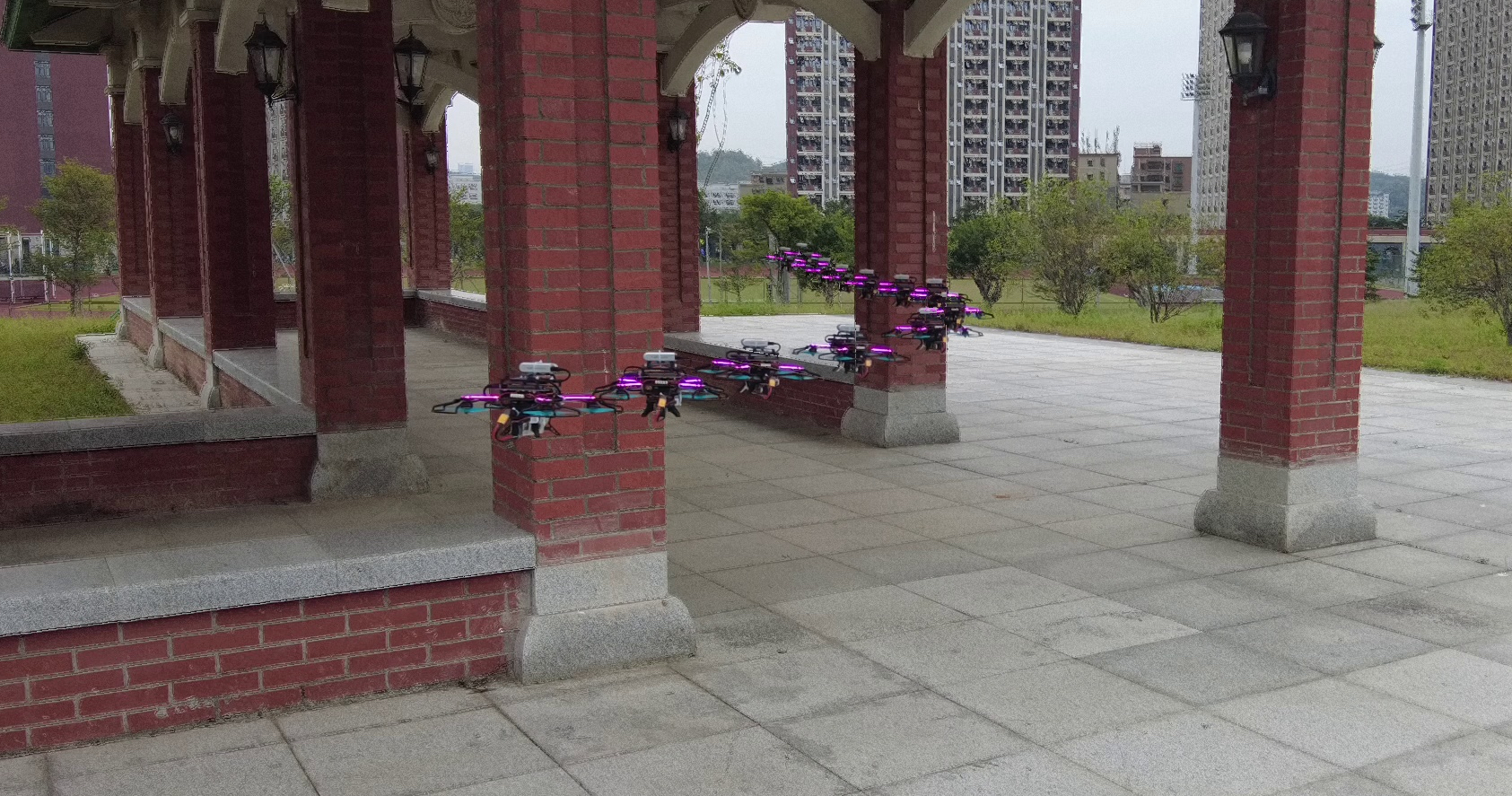
Autonomous navigation in cluttered environments remains a challenge for vision-based unmanned aerial vehicles (UAVs). In this paper, we present PILOT, a privileged imitation learning algorithm for vision-based end-to-end UAV motion planning in cluttered and unstructured environments. The learning process of PILOT is guided by a model predictive control (MPC) expert with access to privileged information. A temporal convolutional network (TCN) is used to implicitly reconstruct all unobservable privileged information based on historical measurements, enabling a UAV to achieve extended spatial awareness beyond immediate visual perception. A trajectory parameterization technique is introduced to ensure motion smoothness and dynamic constraint satisfaction. The proposed PILOT framework is evaluated through extensive numerical simulations and diverse real-world experiments. It demonstrates that the planner learned by PILOT achieves consistent performance comparable to that of the MPC expert, with a significant reduction in computation time of more than 80%. Ablation studies have illustrated the efficiency of both TCN and trajectory parameterization modules. Real-world tests on a custom-built quadrotor have corroborated that the learned motion planner can generate feasible, collision-free trajectories in real time directly using noisy visual observations. Both simulations and experimental results have confirmed PILOT’s capability of strong generalization to previously unseen environments.
Simulation Videos
Quadrotor in a dense environment
Quadrotor in a wall environment
Fixed-wing aircraft in a dense environment
Experiment Videos
powered by Academic Project Page Template